I was walking across Blackfriars bridge this morning and I couldn’t help but wonder. For most of you who probably haven’t walked over it or at least in a while, Blackfriars bridge has been made covid safe by splitting the pavement in two. The quite wide pavement (about 6-7m) has a thick blue line down the middle controlling the foot traffic. You must walk on the left-hand side of this line. To aid this there are arrows on the floor and signs regularly to explain this and why. As if it were necessary. However, while I dutifully walked on my side of the line, a close by women walked on the wrong side, step for step with me the whole way. People had to avoid her. People glared at her. I wanted to understand why she persisted with it. Was this a social experiment? Was there some sort of medical reason? Was she oblivious to the rules?

Rule breaking and equally rule taking is a complicated mix of psychology. On some level I believe rule breaking is necessary and facilitates an improvement of the status quo. That human beings are not automatons to work within a set of parameters in order to generate a repeatable outcome but creative spirits who can synthesise ways to improve their situation. But that’s my perspective, biased by my psychology. However, if we take the devil’s advocate view some would argue that rules, particularly formal ones such as laws, are there to govern the civility of society, to protect the vulnerable and to encourage the smooth working of the “system”.
If we assume perfect design, then most rules are created to the benefit of the majority or group. So, on an individual cost-benefit basis an easy argument could be made that a rule should be broken. For instance, some of the rules around covid, you can’t be in a group of more than 6 in the UK. This makes sense for us as a society to prevent the rapid transmission of a virus that has mortal effects on a large minority of the population. However, on an individual basis, if you’re 20 years old and the virus has no significant danger to you the cost benefit analysis of meeting other 20-year olds in a similar position balances heavily on the rule breaking side of the equation. With a background in economics this has already been defined as a negative externality. Where the cost to society is greater than the cost to the individual. I.e. if one of those 20-year olds were to transmit the virus to their vulnerable 80-year-old grandparent as a result of the contracting it at the meeting. However, that’s not what I’m questioning.
What I want to look at is why we break the rules when there is no discernible benefit or cost to us. The lady on the bridge could have walked 2 metres further to the left but chose not to. For a long time, we’ve accepted that rule breaking makes the individual feel bad. It’s the basis for many of our behavioural models and we’ve used this to drive behaviour change. Research from Harvard and the University of Washington suggests that rule breakers achieve a “cheater’s high” and rather than rules punishing those who misstep, our psychology might reward rule breakers. The research posits that people can feel more capable, autonomous and influential as result of rule breaking.
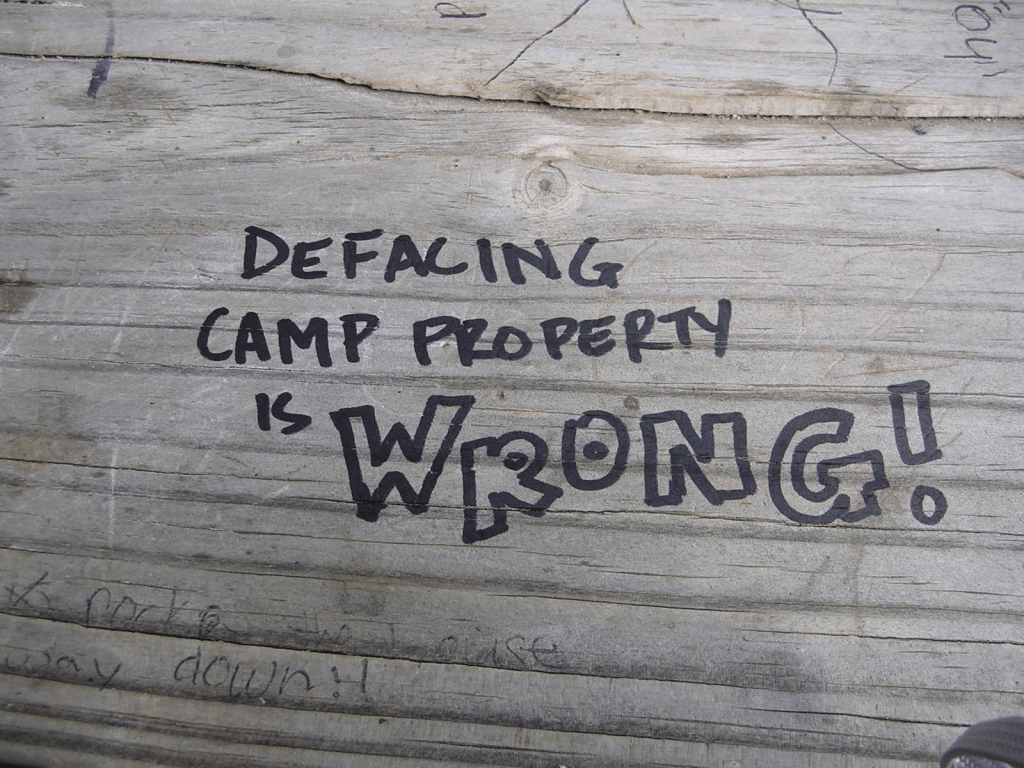
We see this is in everyday examples. It plays out in various scenarios from the sporting arena to tax evasion. However, I hear you say at this point that these also result in a physical or more tangible benefit as well. What about vandalism and littering do they give the individual much tangible benefit? One example I would like to highlight is using a mobile phone while driving. There are very few people who can say they haven’t done it. The benefit here is minimal, but the cost could be catastrophic. I believe here there are other forces in play. Rule breaking is often not a conscious thought, it is often to do with scenarios and situations where we default to the easiest path. Avoiding resistance where it is easy is a near universal human trait. So even when we do not do a cost benefit analysis, we can still all be rule breakers.
The last reason I’d put forward is around power and status and in the extreme entitlement. Many rule breakers believe that breaking a rule is sign of higher intelligence. If you believe this unfortunately there isn’t a lot of evidence to support this. Ariely (if you haven’t read Predictable Irrational, it’s one of my favourites) actually demonstrates that rule breaking can be a sign of higher creativity.

For balance he also says that that creativity can lead to innovation or it can also be highly destructive in the public realm. But if I was to go anecdotal for a moment, I believe a huge part of rule breaking involves entitlement. I work in an industry where, even after 13 years, I can still be astounded at the level of entitlement and arrogance. Citing the example of the BlackRock managing director who dodged his train fares over a prolonged period. While the amount of £43,000 may be significant to all of us, to him, relative to what he earned and the consequential loss of his job this paled into insignificance. I could go on and on about examples in my industry where individuals or even whole companies believe they are above the rules. But I won’t!
Anyway, back to the lady on the bridge, did it give her a high in breaking the rules? Probably not. Was she unconsciously breaking the rules? Possibly. Did it make her feel superior to the others around her? Unlikely. However, my conclusion in this matter is that if we rely on the negative emotional effects being enough to deter people from breaking the rules, we will fail. In economics terms the likeliness of a crime being committed is a function of the probability of being caught multiplied by the cost of the punishment. (A lesson the UK government could learn when breaching the covid rules incurs a near zero probability of being caught). On the psychological basis highlighting the negative effects on society can have tangible effect on reducing the likeliness of the individual breaking the rules. But overall, we are designed to enjoy certain types of rule breaking particularly when rules are designed for the whole rather than the individual. So, rule breaking is an inevitability we should all get used to.
 People Matter(s)